Overview
Engineering plastic modification enhances standard polymers by improving mechanical strength, impact resistance, flame retardancy, and other functional properties. Modification can be achieved through reinforcement, toughening, blending, alloying, or filler addition.
Applications:
Methods of Engineering Plastic Modification:
1. Reinforcement
Fibers or plate-like additives such as glass fiber, carbon fiber, and mica increase rigidity and strength. Example: glass fiber reinforced nylon used in automotive components.
2. Toughening
Adding rubber or thermoplastic elastomers improves toughness and impact resistance. Example: impact-modified polypropylene used in automotive, household appliances, and industrial applications.
3. Blending
Two or more polymers are mixed to achieve target physical, optical, or processing properties.
Blends may form compatible systems or multi-phase structures depending on polymer compatibility.
4. Alloying
Polymers with good compatibility form homogeneous alloys, e.g., PC/ABS or PS-modified PPO. Alloys provide performance unattainable with individual polymers.
5. Filling
Adding fillers enhances mechanical or thermal properties or reduces material cost. Common fillers include talc, calcium carbonate, and mineral powders.
6. Functional Additives
- Conductive fillers to reduce resistivity
- UV stabilizers and antioxidants for weather resistance
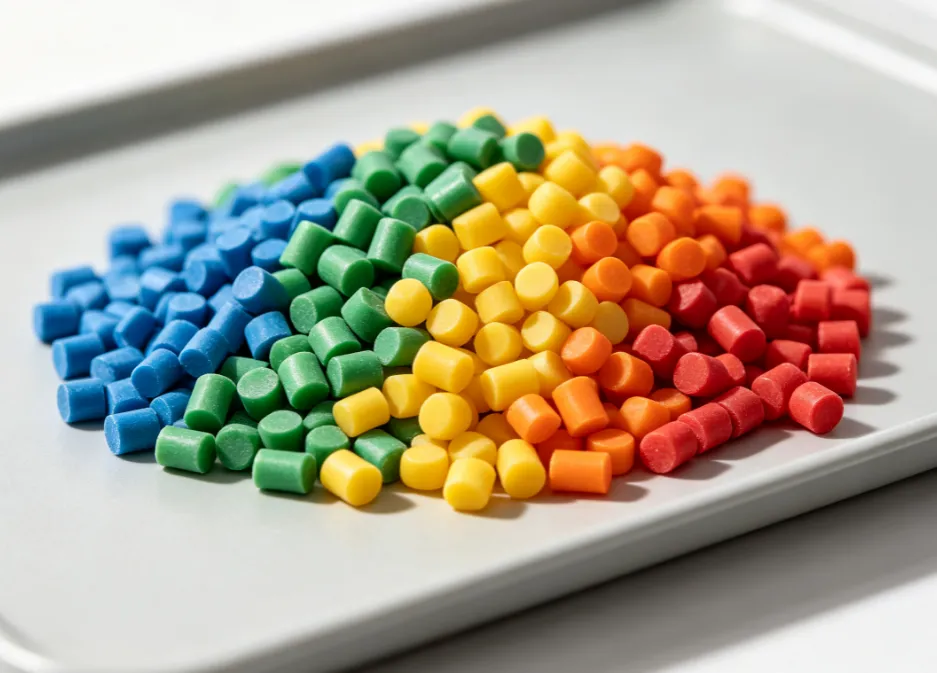
- Pigments and dyes for coloration
- Internal or external lubricants for improved processing
- Nucleating agents to control crystallinity and mechanical or optical properties
Process Solution-Process Workflow with Twin Screw Extruders
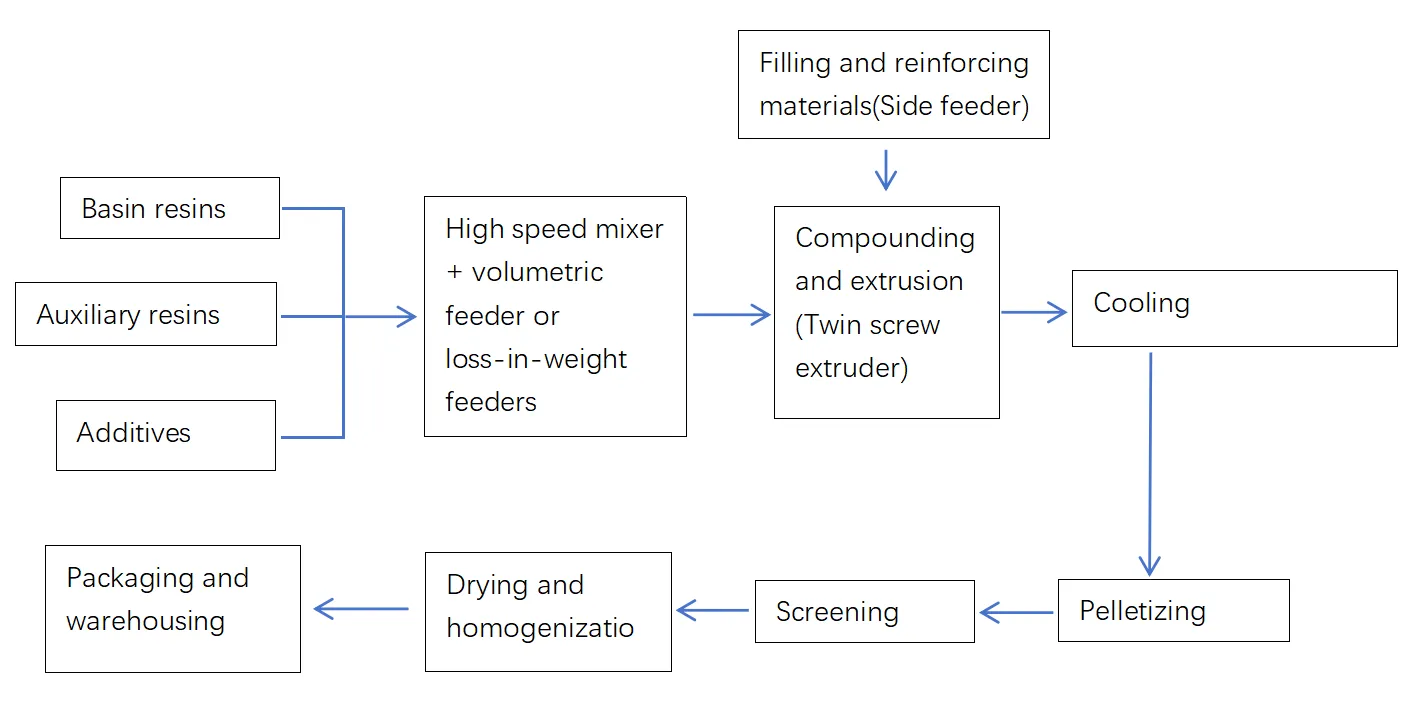
1.Accurate Feeding
Raw materials are fed into twin screw extruders using loss-in-weight systems for precise formulation. Electric vibratory feeders with soft hopper connections enable consistent material flow without segregation.
2.Compounding & Reaction
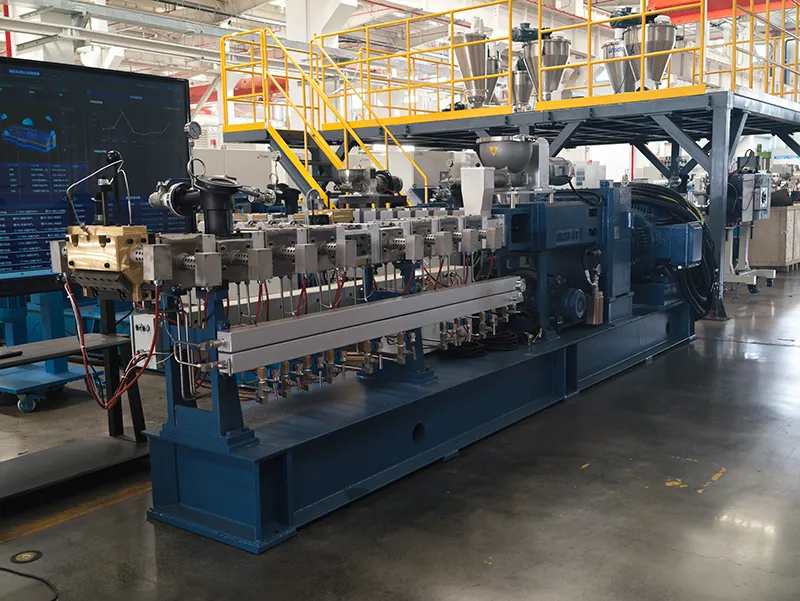
Melting, mixing, homogenization, and reactive compounding occur inside the twin screw extruder. Controlled shear and temperature allow for uniform dispersion of fillers, fibers, and additives.
3.Extrusion & Pelletizing
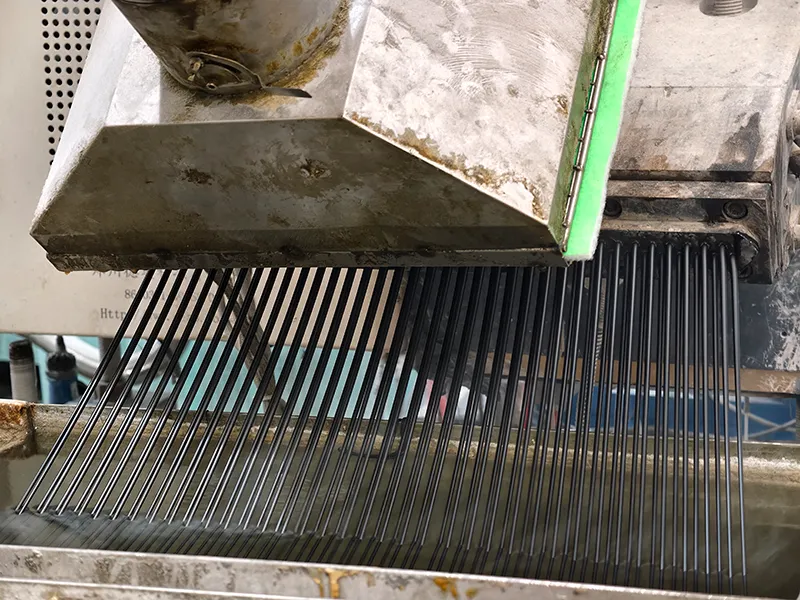
The molten material is then pelletized using strand, water-ring, or underwater pelletizing systems.Options include water-cooled strand, water-ring, or air-cooling pelletizers.
4.Drying & Packaging
Pellets are dewatered, dried, and stored before final packaging. The process enables consistent product quality and minimal moisture content.
Technical Advantages
- No Material Segregation: Maintains uniform dispersion despite differing material densities.
- High Automation: Touch-screen PLC control enables simple operation.
- Accurate Formulation: ±0.5% feeding precision enables consistent quality.
- Labor Efficiency: One operator can manage the entire line.
- High-Performance Motors: High torque, low energy consumption, suitable for various materials.
- Integrated Data & Communication: Supports networked monitoring, multi-material ratio control, and data protection.
Feeding System Specifications
- Accuracy: ≤ ±0.5%
- Power: 220V ±10%, 50Hz, 500mA
- Multi-material ratio and feeding customization
- Manual input of material ratios with automatic calculation
- Automatic signal input interface for multi-component analysis
- Onboard data backup with battery protection
- Communication interface for central control or remote operation
Equipment Options
| Model | Screw Diameter | Max Speed | L/D | Motor Power | Throughput |
| SK63 | 63 | 900 | 40~48 | 250 kW | 500~800kg/h |
| SK73 | 73 | 900 | 40~48 | 400 kW | 800~1200kg/h |
Customer cases
| Customer | Product | Annual Capacity | Solution Provided |
| Cangzhou TDI & Polycarbonate Manufacturer | Copolymerized Silicon PC, High Molecular Weight Brominated PC | 150,000 t TDI, 100,000 t PC | 2 twin screw extrusion lines (SK53 and SK63) |
| ABS Integrated Petrochemical Project | ABS | 600,000 t ABS | 2 twin screw extrusion lines (SK73) |
| Qingdao Sealing & Adhesive Manufacturer | Adhesives, Sealants, Polymers | N/A | 3 HK73 twin screw extrusion lines |
| Tianjin PA6 Chip Manufacturer | PA6 Chips | Largest in Northern China | 3 twin screw extrusion lines (SK73, HK73, HK63) |
Why KYmach Twin Screw Extruders
- High-precision formulation control for complex polymer blends
- Uniform filler and fiber dispersion
- Stable throughput for consistent product quality
- Flexible configurations for various polymer modifications
- Proven reliability in large-scale industrial applications