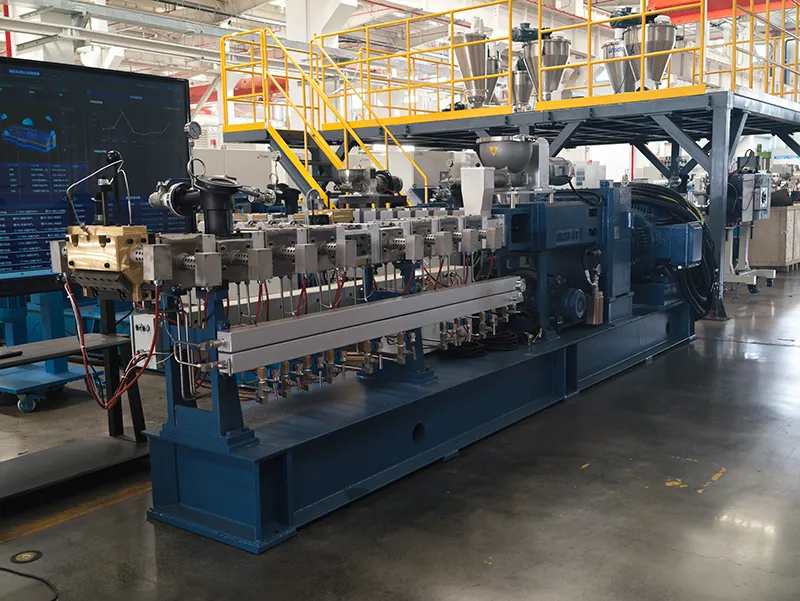
KYmach twin-screw extruders provide efficient polymer and rubber devolatilization, removing solvents, water, and residual by-products with continuous operation, precise temperature control, and flexible vacuum options for high-quality polymer processing.
Overview of Polymer Devolatilization
Twin-screw extruders are widely used for devolatilization of polymers and rubber. The process removes residual solvents, water, and by-products from polymers during continuous extrusion.
Key advantages of using twin-screw extruders for devolatilization include:
- Continuous Operation: The devolatilization process is continuous, enabling consistent product quality and higher production efficiency.
- Efficient Heating and Temperature Control: Precise temperature management enables heat balance and provides sufficient energy for evaporation.
- High Devolatilization Efficiency: Continuous surface renewal along the rotating screws accelerates solvent and by-product removal.
- Modular Design: Flexible screw and barrel design allows multi-stage vacuum ports and precise control over vacuum levels and gas flow, enabling optimized devolatilization for different materials.
Applications
- Polymer solvent removal, dehydration, and by-product elimination
- Rubber solvent removal and dehydration
- High-performance thermoplastics requiring precise devolatilization
– K-resin cyclohexane removal
– SBR C6 oil removal
– Chlorinated polypropylene carbon tetrachloride removal
– HNBR solvent removal
– CSPE carbon tetrachloride removal
– Pharmaceutical alcohol removal
– POM stabilization and monomer removal
– ABS waste powder monomer and moisture removal
– PE/PP grafting monomer/solvent removal
– EVOH dehydration
– Asphalt-based carbon fiber material production
Process solution-Process Flow
1. Material Feeding
Raw materials are accurately metered and fed into the twin-screw extruder, enabling precise control over formulation.
2. Devolatilization Extrusion
The extruder melts, mixes, and processes the polymer or rubber under controlled temperature and shear. Multi-point vacuum ports remove solvents, water, and residual by-products efficiently.
3. Pelletizing or Downstream Transfer
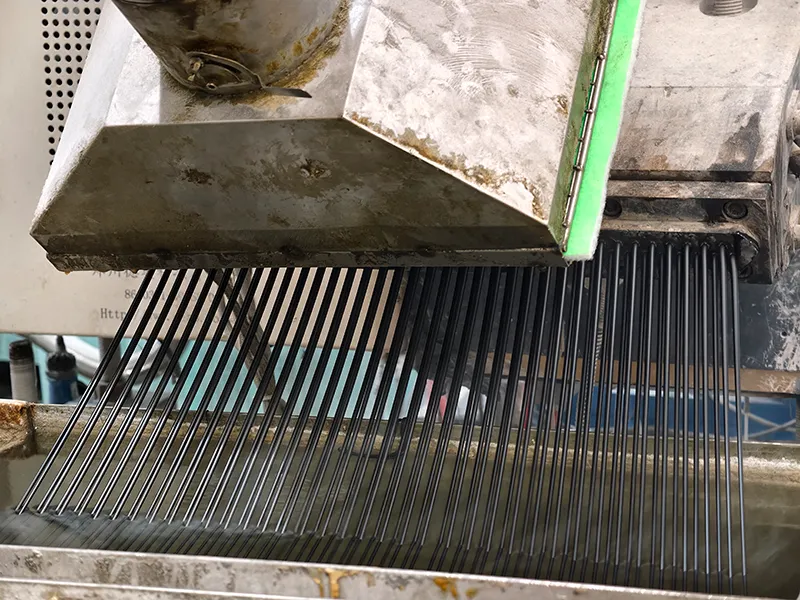
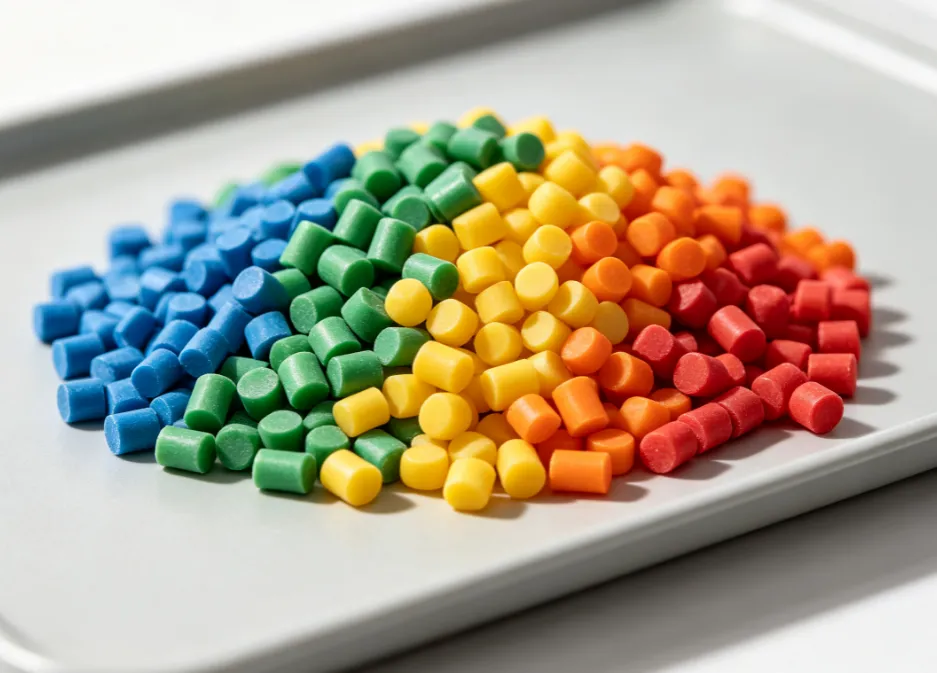
The processed polymer or rubber melt is either pelletized using water-cooled or underwater pelletizers, or sent directly to downstream equipment for further processing.
Material feeding ➡ Devolatilization extrusion ➡ Pelletizing or direct transfer to downstream equipment.
Equipment options
| Model | Screw Diameter(mm) | Max. screw speed(rpm) | L/D | Motor Power (KW) | Throughput(kg/h) |
| HKV54 | 54 | 150–300 | 68 | 22–45 | 0.05–0.1 |
| HKV77 | 77 | 150–300 | 68 | 55–110 | 0.15–0.25 |
| HKV100 | 100 | 150–300 | 68 | 90–200 | 0.3–0.5 |
| HKV140 | 140 | 150–300 | 68 | 250–450 | 0.75–1.2 |
| HKV189 | 189 | 150–300 | 68 | 450–900 | 1.5–2.0 |
Why Choose KYmach Twin-Screw Extruders for Devolatilization?
- Continuous processing for higher efficiency and consistent quality
- Precise multi-zone temperature control and modular screw design
- Flexible multi-stage vacuum for optimized solvent and by-product removal
- Scalable production from lab-scale to large industrial throughput