Introduction
Thermoplastic polyurethane (TPU), with its excellent wear resistance, high elasticity, oil resistance, and a wide hardness range, has been widely used in automotive components, wires and cables, consumer electronics, medical devices, footwear materials, and new energy sectors.

However, as end-product requirements for material performance continue to rise, standard TPU grades are increasingly unable to meet the growing demands of specialized applications. Through compounding and reactive extrusion, manufacturers can further develop TPU materials with higher performance and a broader range of applications to meet the needs of various industries for flame retardancy, reinforcement, weather resistance, and functional performance.
In this process, the selection of extrusion equipment directly impacts the effectiveness of TPU modification and production efficiency. A suitable extruder for TPU must not only meet material processing requirements but also ensure a stable production process and consistent product quality.
This article will focus on the main application areas of TPU compounding, processing challenges, and equipment selection requirements, providing an in-depth analysis of why co-rotating twin-screw extruders have become the mainstream solution for high-performance TPU modification.
Why Does TPU Require Compounding and Modification?
The fundamental purpose of TPU compounding and modification is to “maximize advantages while compensating for inherent limitations” or to “achieve synergistic performance improvements”—that is, by introducing functional additives or compounding with other polymer materials, TPU is endowed with new functions, its inherent weaknesses are improved, or an optimal balance between cost and performance is achieved. Currently, TPU compounding and modification primarily focuses on the following areas.
| Modification Objective | Main Application Fields |
| Improved Flame Retardancy | Wire & cable, electronic appliances, new energy vehicles, energy storage systems |
| Enhanced Wear Resistance & Cut Resistance | Industrial rollers, mining equipment, conveyor systems |
| Hardness and Elasticity Modification | Footwear, sports equipment, consumer electronics |
| Improved Weather Resistance & Aging Resistance | Outdoor products, building materials, automotive exterior components |
| Enhanced Oil & Chemical Resistance | Automotive oil hoses, industrial seals, medical devices |
| Electrical Conductivity and Anti-Static Properties | Electronic packaging, precision electronics, industrial protective equipment |
Different modification objectives correspond to different processing methods, which also means that extrusion equipment must possess different mixing capabilities, feeding methods, and temperature control capabilities.
Typical Processing Challenges in TPU Compounding/Modification
High-performance compounding and modification of TPU depend not only on formulation design but are also influenced by the material’s inherent properties. These processing challenges collectively constitute the typical processing conditions for TPU extrusion and place higher demands on the extrusion equipment’s mixing, temperature control, and stable operation capabilities.
Compared to common thermoplastics such as PE and PP, TPU exhibits the following characteristics:
1. High Melt Viscosity
Hydrogen bonding within TPU molecular chains results in high melt viscosity, making its rheological behavior highly sensitive to temperature and shear rate.
Key Challenges:
- High viscosity reduces the dispersion efficiency of additives and fillers, leading to agglomeration;
- High shear generates significant heat, increasing the risk of localized overheating and degradation;
- High flow resistance may lead to unstable conveying and output fluctuations.
2. Strong Hygroscopicity
TPU, especially polyester-based TPU, readily absorbs moisture from the air.
Key Challenges:
- Moisture during processing can cause hydrolytic degradation, leading to a decrease in molecular weight and a decline in performance;
- Moisture vaporization can cause bubbles, silver streaks, and surface defects;
- Raw materials must be thoroughly dried, and moisture reabsorption during handling and conveying must be prevented.
3. Thermal Sensitivity
TPU has a narrow processing temperature window and requires precise temperature control.
Key Challenges:
- Excessively high temperatures or prolonged dwell times can cause discoloration and performance degradation;
- Excessive heat generated by high shear increases the difficulty of temperature control;
- Material residence in dead zones can lead to localized degradation.
4. Formulation Complexity
TPU modification typically involves multiple components, including fillers, additives, flame retardants, fibers, or other polymers.
Key Challenges:
- Different components must be uniformly dispersed and stably blended;
- Materials such as powders, liquids, and fibers place higher demands on the feeding system;
- Reactive modification also requires precise control of the reaction process.
In summary, the core challenges of TPU compounding and modification lie in simultaneously managing high viscosity, high shear heat, strict moisture protection, a narrow processing window, and complex formulation systems. Therefore, ideal TPU extrusion equipment must possess strong mixing capabilities, precise temperature control, efficient degassing, and stable feeding capabilities to ensure the performance consistency of the modified materials.
What Makes the Best Extruder for TPU Compounding?
To address the challenges of high viscosity, heat sensitivity, moisture absorption, and complex formulations in TPU compounding and modification, co-rotating twin-screw extruders (CTSE) have become the mainstream choice for TPU modification processing due to their efficient mixing, precise control, and flexible configuration capabilities.

Superior Mixing and Dispersion Capabilities
Addressing Challenges: Difficulty in mixing high-viscosity melts and uneven filler dispersion.
Co-rotating twin-screw extruders generate forced conveyance and high-shear mixing through two meshing screws, achieving distributive and dispersive mixing.
- The forced conveyance structure enhances the conveyance stability of high-viscosity TPU, reducing slippage and output fluctuations;
- The meshing zone generates strong shear forces, which aid in the dispersion of functional components such as fillers and flame retardants;
- The modular screw design allows for adjustment of conveying, mixing, and shear capabilities according to different formulations.
Precise Temperature and Shear Control
Addressing Challenges: TPU has a narrow processing window and is prone to degradation due to overheating.
The CTSE enables precise adjustment of melt temperature and shear intensity through barrel temperature control, screw speed, and screw configuration design.
- High-efficiency heat exchange reduces the risk of localized temperature spikes;
- Adjustable shear input helps avoid excessive shear-induced degradation that could degrade material performance;
- Stable process control ensures batch-to-batch consistency of the product.
Flexible Material and Formulation Adaptability
Addressing Challenges: Processing multi-component and multi-form materials is complex.
TPU modification typically involves multiple components, such as powders, granules, liquid additives, or reinforcing fibers; CTSE offers superior formulation flexibility.
- Stable processing of materials with different forms and flow characteristics;
- Supports multi-point feeding methods, including side feeding and liquid injection;
- Suitable for processes such as filler modification, flame retardant modification, reinforcement modification, and reactive extrusion.
Continuous Production Stability
Addressing Challenges: Quality fluctuations during extended production runs.
- Co-rotating intermeshing screws feature excellent self-cleaning capabilities, reducing the risk of material retention and localized degradation.
- At the same time, stable conveying and mixing ensure that the material undergoes a more consistent processing history, enhancing the performance stability and appearance consistency of modified TPU.
Synergy with Auxiliary Systems
TPU compounding production requires the extruder to operate in synergy with drying, feeding, degassing, and pelletizing systems.
- Dehumidification and drying system: Reduces moisture in raw materials to prevent hydrolytic degradation;
- Loss-in-weight feeding system:Ensures stable ratios for multi-component formulations;
- Vacuum degassing system:Removes residual moisture and volatiles to improve material quality;
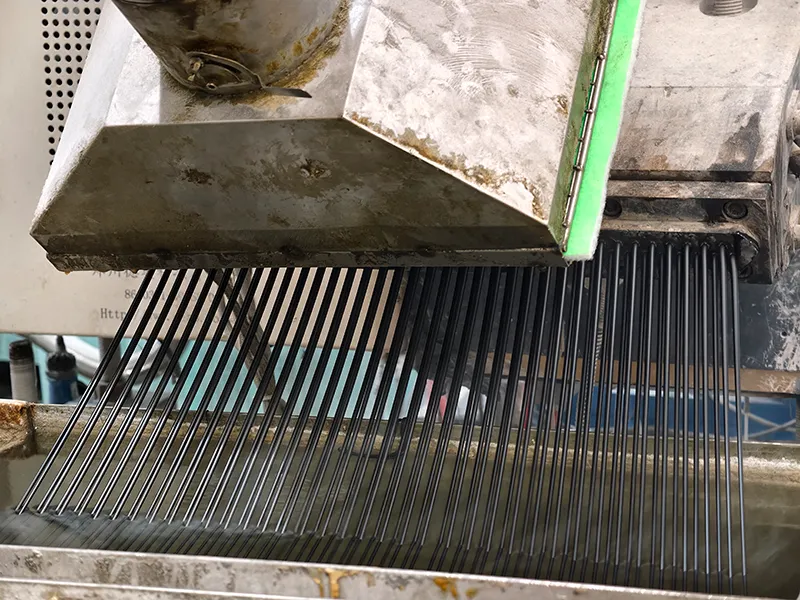
- Underwater pelletizing system: Adapted for high-viscosity TPU melts to produce uniform pellets.
Recommended Twin-Screw Extruders for TPU Compounding & Modification
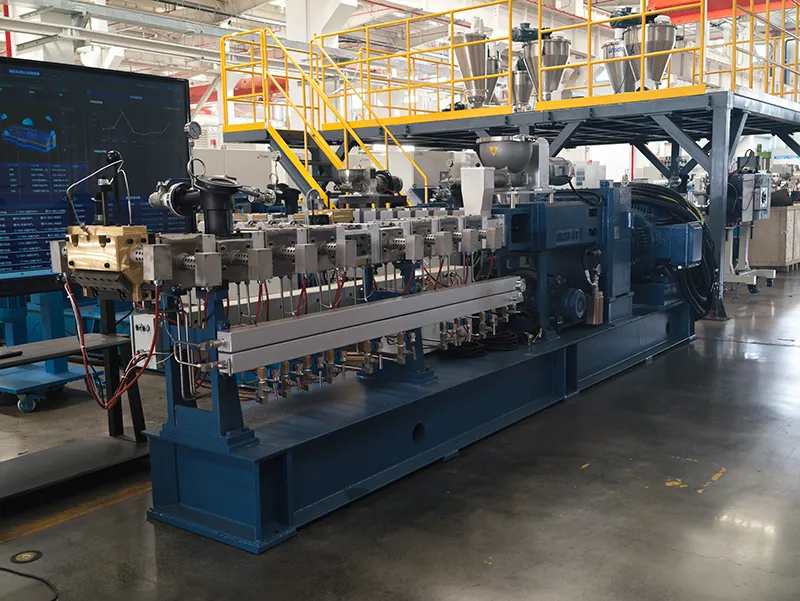
To meet the requirements for mixing capacity, processing stability, and formulation adaptability during TPU compounding and modification, KYmach offers co-rotating twin-screw extruders in a variety of specifications to accommodate different needs—from experimental development and pilot-scale validation to continuous industrial production.
Among these, both the SK and HK series twin-screw extruders feature a modular screw design, allowing for flexible configuration of the feeding, melting, mixing, degassing, and pressure-building zones based on the characteristics of the TPU formulation. They are suitable for TPU filler modification, flame retardant modification, reinforcement modification, polymer alloy modification, and other functional compounding applications.


HK73 vs. SK73 – Which Twin-Screw Extruder is Right for Your TPU Application?
Both the HK73 and SK73 are high-performance co-rotating twin-screw extruders designed for TPU compounding. They share the same modular barrel and screw platform, enabling flexible screw configurations for different TPU formulations. The selection mainly depends on the required throughput, formulation complexity, and torque demand.
| Item | HK73 | SK73 |
| Best for | Standard TPU compounding | High-performance & high-filled TPU compounds |
| Throughput | 600–1500 kg/h | 750–2200 kg/h |
| Motor Power | Up to 355 kW | Up to 560 kW |
| Torque Capability | Standard high torque | Ultra-high torque |
| Recommended Applications | General TPU compounds, color masterbatch, flame-retardant TPU, moderate filler loading | High filler loading, glass fiber reinforced TPU, mineral-filled TPU, high-viscosity TPU, demanding engineering compounds |
When to Choose HK73
The HK73 is recommended for most conventional TPU compounding applications where stable production, excellent dispersion, and cost efficiency are the primary considerations.
Typical applications include:
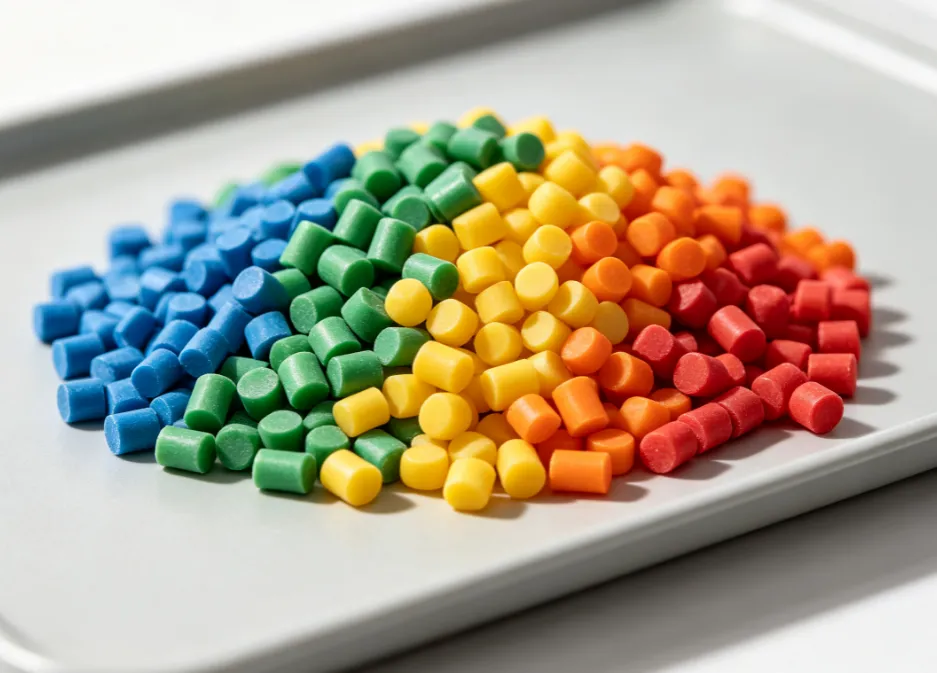
- TPU color masterbatch
- Flame-retardant TPU
- Soft TPU compounds
- TPU with moderate levels of mineral fillers
- General cable, film, footwear, automotive, and consumer-product compounds
For formulations with moderate viscosity and medium filler loading, the HK73 provides an excellent balance between investment cost, production efficiency, and processing performance.
When to Choose SK73
The SK73 is designed for more demanding compounding applications that require significantly higher torque and energy input.
It is the preferred choice when processing:
- High filler loading TPU compounds
- Glass fiber or carbon fiber reinforced TPU
- Highly filled flame-retardant formulations
- High-hardness or high-viscosity TPU grades
- Engineering TPU alloys and specialty compounds
- Applications requiring maximum throughput and long-term continuous production
With its substantially higher motor power and torque capacity, the SK73 maintains stable output even under high mechanical loads, enabling higher throughput while preserving melt quality and dispersion performance.
Our Recommendation
- Choose HK73 if your production focuses on standard TPU compounding with medium output requirements and conventional formulations. It offers an excellent balance of performance, reliability, and investment cost.
- Choose SK73 if your formulations involve high filler content, high viscosity, fiber reinforcement, or demanding engineering compounds, or when maximum productivity and future production expansion are important. The higher torque reserve provides greater processing stability and wider formulation flexibility.